A project by Bryan Falkowski

Manage Claude Code sessions like a software team, not a stack of terminals.

Each session gets a role on a team you already know how to run. A Lead plans, developers build, reviewers check, and you approve. As a team earns your trust, it does more on its own, and you can run more teams at once.

One teamIt starts by asking before it acts.
Earned autonomyYou turn on one power at a time, when the evidence supports it.
A building of teamsMany rooms at once. A lobby that lights the room that needs you is planned.
Walk in Read the code
The trailer, robot editionSound is off until you turn it on.

Why a team, and not more terminals

Skills and agents are easy to start and hard to keep track of. A software team is something every developer already knows how to run. So each session gets a role, a desk and a ticket, and the work moves through the same steps as any team's: plan, build, review, merge.

Roles you knowA Lead, a PM, developers and reviewersEach session has one job and its own brief, so you can tell at a glance who is doing what, and who is stuck.
The steps you knowTickets, pull requests, reviewWork moves on GitHub Issues and pull requests. Nothing merges until a reviewer checks it.
building58 · main A ticket step 1 of 6

The loop

The room builds the next version of itself.

Its sessions work on the room's own repo. They write the code, test it, merge it, and then the room pulls it and restarts as the new version. The next ticket starts from there.

1 · A ticket A ticket asks the room to change itself. The PM files it, or I do. #153 Trailer: no ping pong game with one player
Click a step to stop on it.
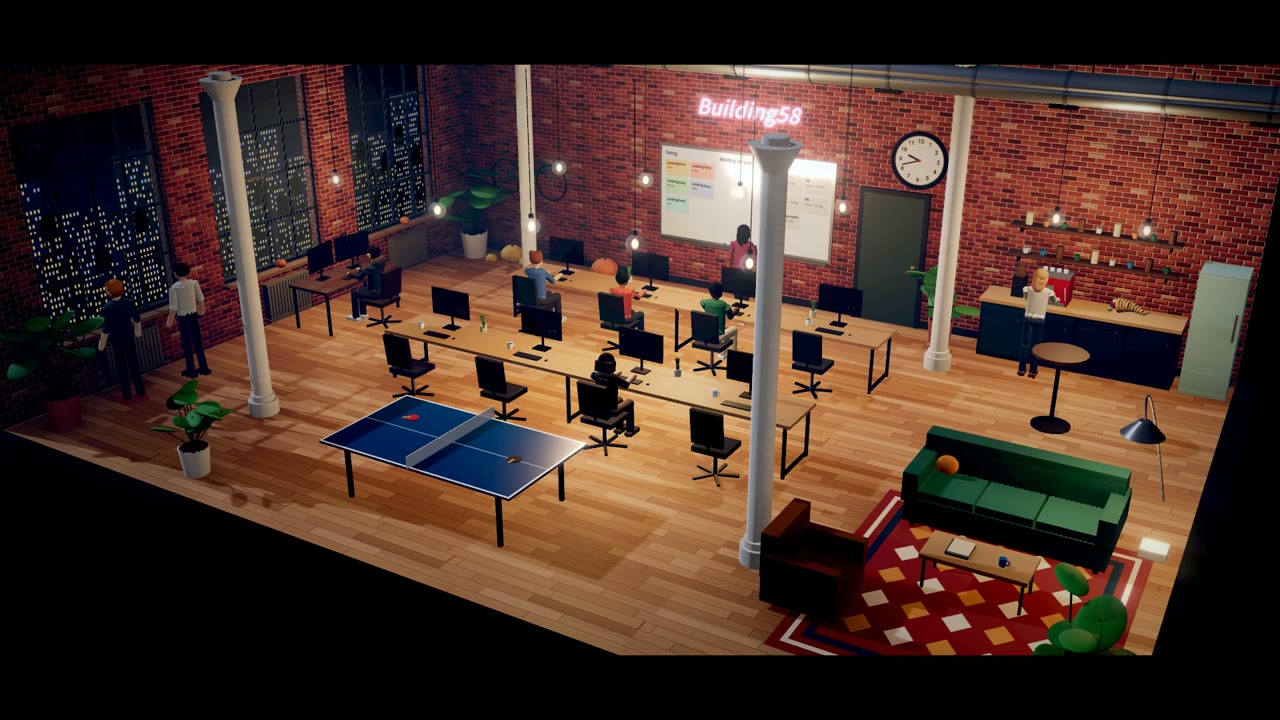
The room before: the people edition
Before: the room as it ran on Nov 13
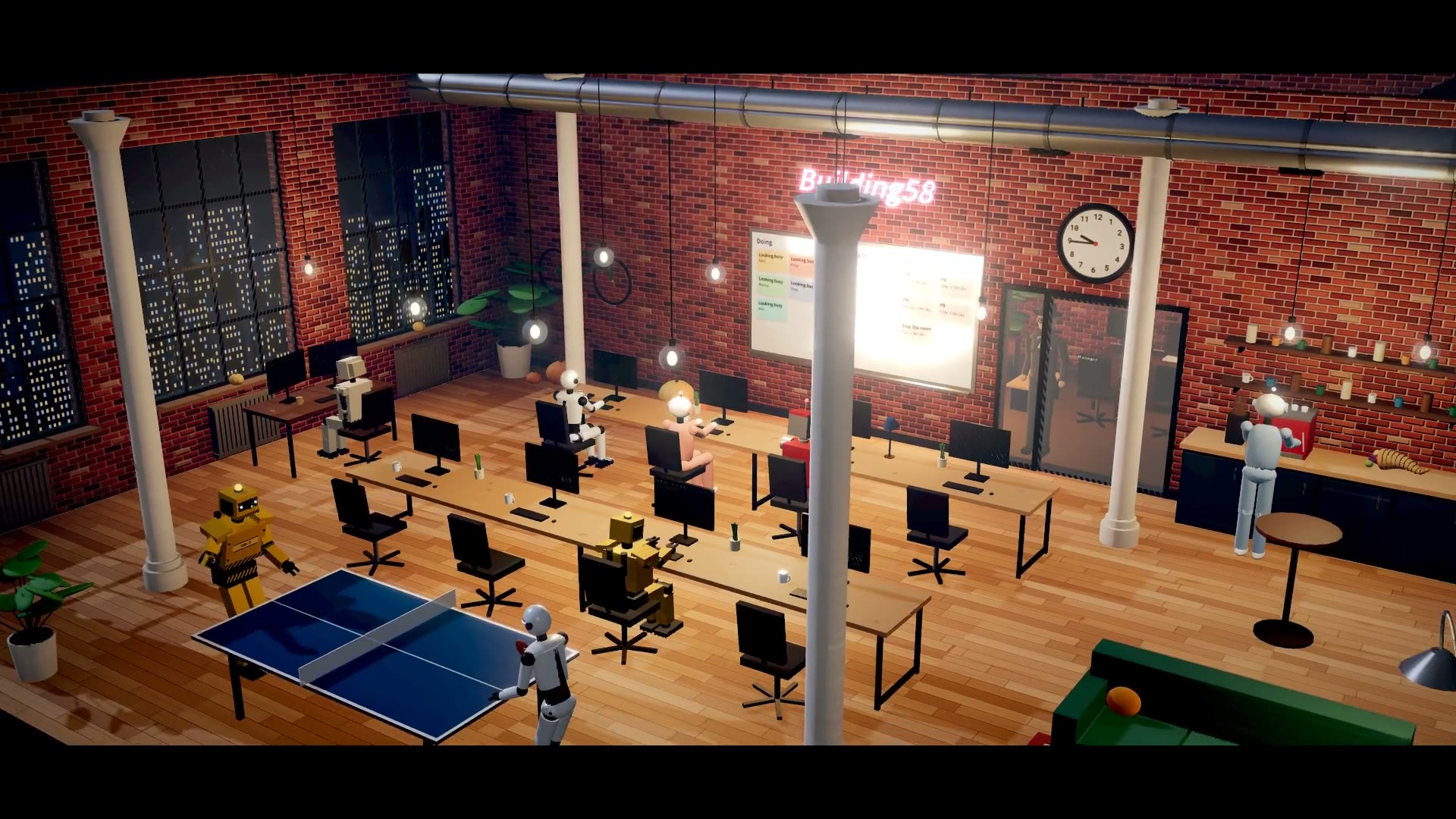
#150 · #151 · #152 The room wrote the robot edition, tested it, merged it, pulled it, and restarted as it.
The room after: the robot edition
After: the same room, from its own pull requests
One merge at a timeWith rollback on, Update takes new merges one at a time, oldest first, and goes on only once the new relay passes its check.
A failed version rolls backWith rollback on, a relay that fails its check goes back to the last commit that worked, and the page says which.
Sessions survive the restartA relay restart leaves every session running, with its output, and the new relay takes them back.
It cannot rewrite its own rulesThe Lead never merges a change to the house rules, the constitution or the lint rules.

The real room

This is what it actually looks like.

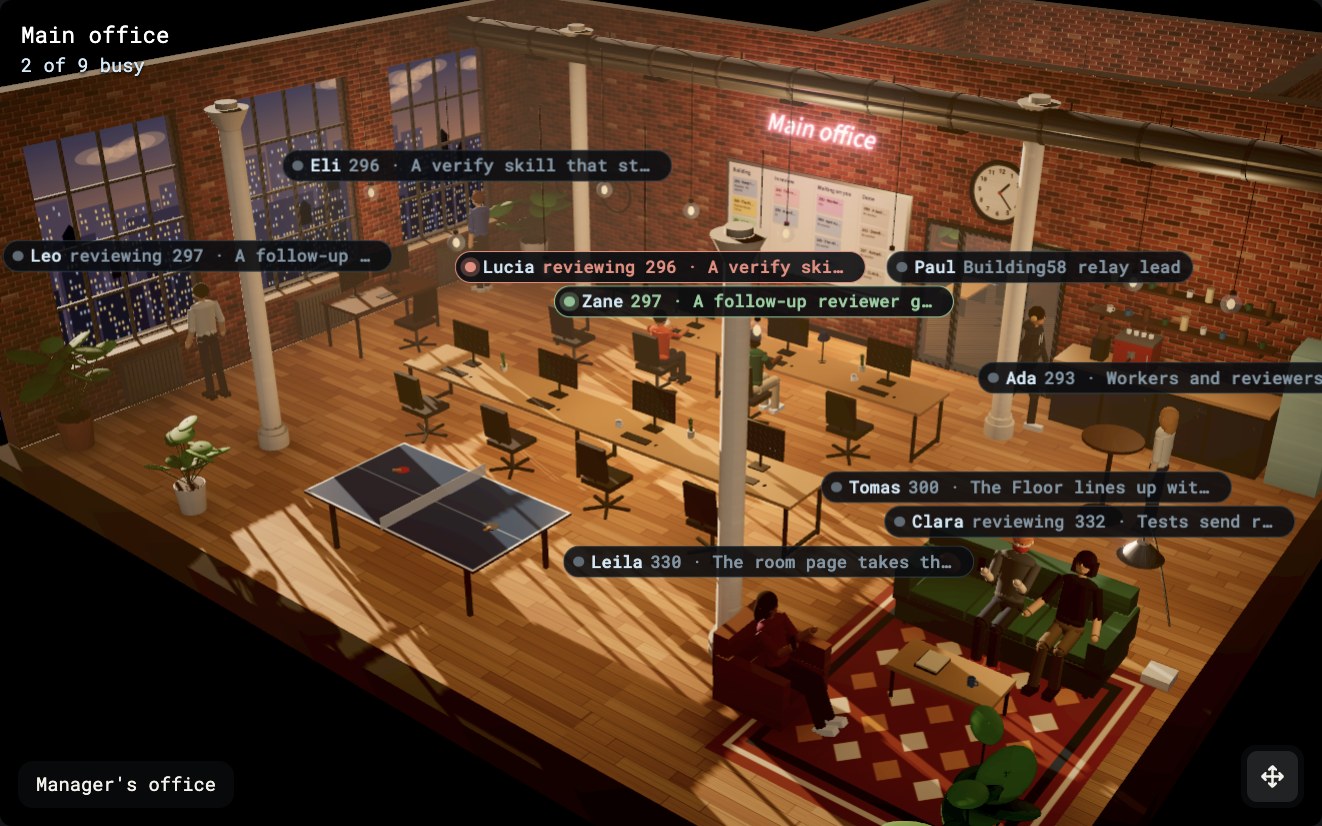
The main office, at work on Building 58's own code.

Walk in
The main office, a 3D brick loft. The corner reads Main office, 2 of 9 busy. Name tags float over the workers, such as Lucia reviewing 296, Paul Building58 relay lead, and Eli 296, a verify skill. A Board with ticket columns hangs on the far wall. A Manager's office button sits in the bottom corner.
  1. 1How many of the nine desks are busy right now.
  2. 2Each tag is a Claude Code session: its name, its job, and the PR or ticket it is on. Lucia is reviewing PR 296.
  3. 3Paul is the Lead. He plans the work and starts the tickets.
  4. 4The Board on the wall holds the tickets. Anything that waits on you goes in its Needs your attention section.
  5. 5Your office. You approve the work, and you turn on the next power.

A screenshot of the real room page. The tags match pull requests in the Building58 repo.

How it works

Under the hood

The room looks like a game. Underneath, a relay runs every session, and each part of it keeps one rule.

All 13 parts, with code and tests
  1. 01Sessions keep running when the relay restartsA session host keeps each claude process running through a restart.
  2. 02Hooks do not slow a session, and do not get lostA hook waits 1 second at most and always exits with code 0. While the relay is down, hooks wait in a queue.
  3. 03The relay types only when it is safeIt never types into a session that shows a question or a menu.
  4. 04Each task gets its own checkoutEach task also gets its own branch, stub .env file and ports.
  5. 05Autopilot starts, reviews and merges workIt merges only the exact commit that was reviewed, and only when every check passed.
  6. 06The relay updates itself, and can roll backIt pulls its own merges and restarts on them.
  7. 07Tokens and rungs limit each sessionA session's token reaches only what its role needs. Each Lead power is off until you turn it on.
  8. 08Evals check each change to a briefIf you change the PM's brief, npm test fails until the eval runs again.

What a room can build

Give a room a spec. Get back software it has already used.

A room does not only work on its own code. It builds new software in a repo of its own, then uses that software on its own work. The Devs find the bugs and ask for the changes, so what comes back has been field tested.

  1. 1 SpecI write it with the room's PM.
  2. 2 TicketsThe PM files them from the spec. I approve them.
  3. 3 BuildDevs build it in its own repo, under the room's rules.
  4. 4 Use itThe room runs it on its own work and files what breaks. Back to 2.

A separate project, built by a Building 58 room · in development

Exhibit

Every pull request brings its own evidence.

When agents open more pull requests than a person can read, the question changes from "is this code good?" to "is this evidence strong enough that nobody needs to read the code?"

  • Learns from historyTraces each fix back to the pull request that added the bug, and turns what got through into rules.
  • Checks each pull requestTests on the base and the head, a test that failed before and passes now, and planted bugs on the changed lines.
  • Gives a verdictMeets policy, or needs a person, and it always lists the gaps.

It checks its own pull requests in shadow mode. Its two field-test repos are Building58 and edd-platform.

exhibit / check · PR #112 Needs a person
Kind: relay-core · risk high · policy v3
Tests on base and head
1 test failed before the change. All pass now.
A test that failed before
relay/test/watch-restart.test.js
Mutation on changed lines
23 of 25 caught, 92%. This kind needs 85%.
Restart run: missing
Run the restart check and attach its log. Until then a person reviews this PR.
Example output, from Exhibit's explainer page.

Room B · edd-platform

A second room as a first user

Its PM used an older eval platform of mine end to end, as a new user would, and filed a ticket for each broken, confusing or missing thing.

The Second Office's First User

The trust ladder

Autonomy, one level at a time.

Each level lets the room do one more step without a person. Only a person changes the level, in the room's settings, and can turn it back at any time.

  1. 0You driveThe relay reviews each new PR once and sends the findings to the Dev. You start, move and merge all work.
  2. 1Review loopAfter each push, a reviewer checks the new commits and the Dev fixes them, without you, up to a limit of automatic reviews.
  3. 2The Lead keeps work movingThe Lead moves cards on the Board, accepts tickets from Triage, and stops sessions that are safe to stop.
  4. 3The Lead starts ticketsThe Lead also starts Ready tickets you approved, one at a time, within limits you set.
  5. 4The Lead mergesThe Lead also merges a PR when it is ready: a review of the latest commit, every blocking finding fixed, all checks green, no conflicts, and no decision left for you.
  6. 5AutopilotMy room runs hereThe relay runs the whole loop itself. It starts each approved ticket, reviews each push, sends findings to the Dev, and merges when the review says merge and all checks pass.
  7. 6Autopilot with evidenceAn ideaThe same loop, but the relay also needs Exhibit's evidence for the PR before it merges: a check the builder cannot tune to. Then some kinds of PR could merge with less review.

Each level has brakes

Autopilot can merge without me, so it carries the most brakes.

  • It merges only when the review says merge and every check passes.
  • It never merges a change to CLAUDE.md or the constitution. Those go to me.
  • A daily merge limit and a limit on work in progress, both set by me.
  • A task that nothing moved for 30 minutes comes back to me.
  • If a new version fails, the room rolls back to the last working commit.

Not built yet

Exhibit on this repo. Level 6 needs it. Today Exhibit checks only its own pull requests, in shadow mode. Planned.

A monitor. Something that watches what shipped and files tickets for what it finds. An idea.

Lint, tests and a secret check run in CI on every pull request. When a told rule keeps failing, the fix is a check, not more words. Read the constitution

In active development

Building 58 is still busy building itself.

5 built · 2 in development · 1 planned · 2 ideas

The room changes every time it merges a pull request into itself. The roadmap shows what is done and what comes next.

See the roadmap

Writing about it

More writing

Trailers

All four films, with the realistic versions
The robot edition3D, 83 seconds
The people edition3D, 79 seconds